
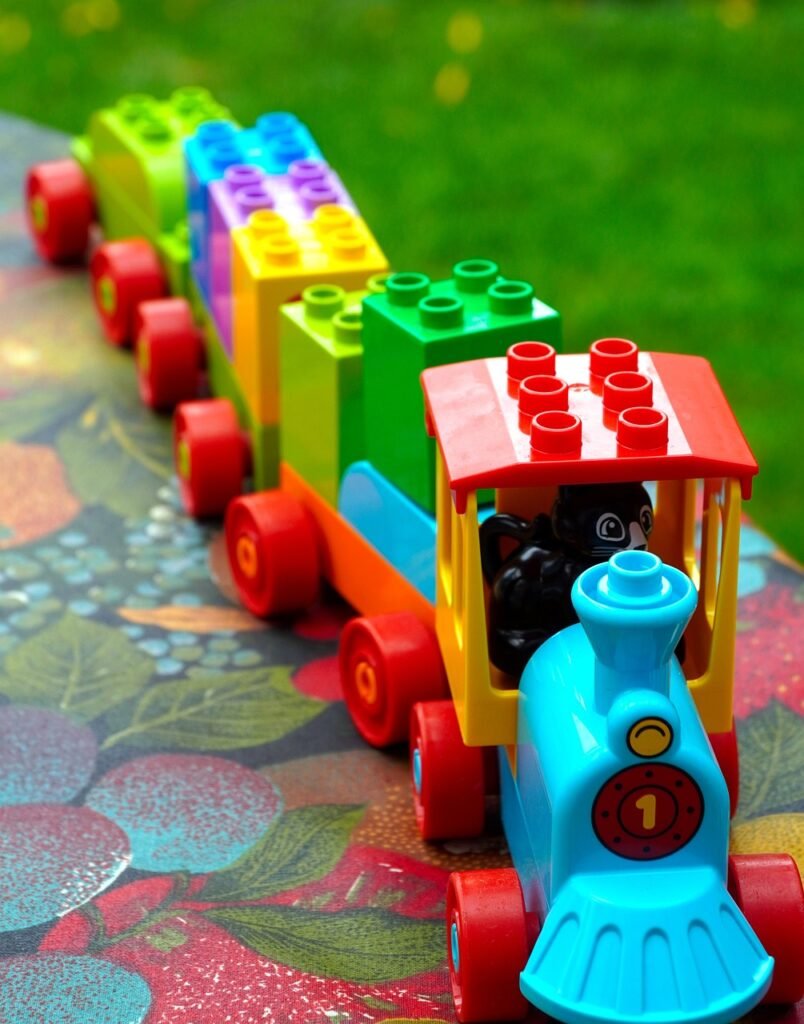
Are toys being used for their intended purpose?
I was upstairs and my four year old daughter wanted me to come downstairs and play with her. I told her I was busy and she decided that she wanted Dad instead. I informed her that her Dad had gone to the shop and immediately, she decided that she wanted him to buy her a new toy. She continued to scream saying that she is bored. I asked her why she was not playing with her toys, she said that she didn\’t like them anymore because they are boring.

This got me wondering about the purpose of having toys, because my daughter has a lot of toys, especially now that she was given many toys as Christmas presents. But she still seemed to want more and more toys. How do we streamline our children\’s toys to make sure that our children still find them enjoyable? Even if they’ve been in the house for a while. What other ways can we introduce toys daily without them being overwhelmed by too many toys? What do the toys communicate, and what values do the toys instil in the child when they are just given and not earned?
What are the purposes of toys?
Toys are meant to have a positive effect on a child\’s development, enhance their sensory abilities, develop problem solving skills as well as learn life skills. But when a child has mastered the toy and finally feels done playing with it, or has found the toy challenging, the toy then becomes boring. So the challenge is getting the child to engage with toys that are age-appropriate and also have a toy rotation or recycling in place.
When buying toys, always consider the purpose of the toy. For the child to learn something, or for the child to be entertained for hours on end. At times we tend to buy toys just because they are the in-thing at the time, instead of it being something that the child would cherish and find beneficial to their development. I find that sometimes children get overwhelmed by the stimulus of lights and glitter, impairing their appreciation for one single toy, thus making toy rotation/recycling essential.

Are toys encouraging consumerism in our children?
Is the availability of too many toys within the home making children have an insatiable consumer mindset?
Is it instilling a sense of entitlement, making even tiny cheap toys available at every request?
By buying toys each time one goes shopping, are we also teaching our children to not have self control?

Are toys stifling the children’s creativity?
This got me thinking that as children in Africa, we never used to have toys that were shop-bought. Having to make toys as children encouraged us to be innovative. The toys we played with were either up-cycled or recycled from various items or materials. We used to use things like empty cans to make stilts, corn cobs and pieces of fabric to make dolls, wire from inside electric cables to make cars and plastic bags to make balls. Shop- bought toys were therefore really appreciated. It’s got me wondering that if our children were involved in making the toys they play with, would they appreciate them better? Are toys stifling the children’s creativity? Should toys only be bought as a reward for good behaviour and also introducing a schedule for when the toy rewards are to be expected if deserved?

Are your children taking part in tidying up the toys?
Toys are meant to encourage our children\’s development and teach them to acquire some skills. Toys are meant to keep our children occupied such that we can perform other tasks while they are entertained by those toys. Toys are meant to enhance the sensory skills. The act of tidying up of toys is also a life skill that can be taken far into our children\’s futures.
I find that within the home we have a lot of toys, and end up not knowing what toy the children played with that day, or even what they learnt from the toy. My niece and her husband have taught their son to play with one toy at time. The little boy will take one toy from the toy box and play with it. Once he’s done with that one, he returns it to the toy storage area, before getting another toy. I found this fascinating as the child seemed to have become accustomed to this and always kept his room tidy.

I found this process very organised and so was her house. So the question is, within the home, how are we tidying up the toys? We need to allow our children to tidy up after themselves, rather than finding ourselves tidying up after them, as we feel we can do it faster and more efficiently at the same time. As parents we need to be able to let go of perfection when teaching our children a life skill, and allow them to learn by doing.
Another way of ensuring that the toys are in the right compartment is by labelling or sticking pictures to your storage areas, helping the little ones who are not yet able to read.
Charity begins at home
Recently I decided that each time we buy a new toy, I should tell my little one to find another toy that she’s not using anymore and put it away. When she was younger, I used to be the one who just took the toys and decide which one she’s not using anymore. But now I have decided to involve her in streamlining her toys, in the hope that it may instil in her a sense of charity. Now she knows that if she asks for another toy, she has to give one away. It can also be a way of ensuring that your child realises that they can only use so much and have self control. It also encourages your child to live in a tidy environment as well as assuming some form of responsibility.
Do the toys reflect who you are?

Are there toys which reflect your child\’s identity?
I also found that there are very limited toys which are brown skinned in the shops. However, on reflection, the non-white population is less than 20% in the UK so it makes sense. However on surfing the net, I realised that the only toys that represented the African culture were the dolls. I struggled to find masculine toys that were representative of the people of colour. I then realised that there is still a lot of work to be done to draw our children into knowing more about our culture and identity through toys.

What other indoor toys can encourage children to be active?
I am also conscious that living in a cold climate, and children being in lock down, they may end up sitting around as active. Therefore when acquiring toys, it is essential to get ones that will encourage children to safely expend energy. The indoor trampoline keeps her occupied and doubles up as a playpen for the dolls too. We also bought an alphabet mat, which besides learning and practising her alphabet, she also plays hopscotch on it.

Indoor/outdoor trampoline, keeps my .little one busy

So I implore you to think deeply when acquiring toys for your children. Think of the purpose of the toys and ensure that your children will not only play with the toys, but also learn some valuable life skills.
How are you managing toys within your home? Please share your experiences in the comments box below.